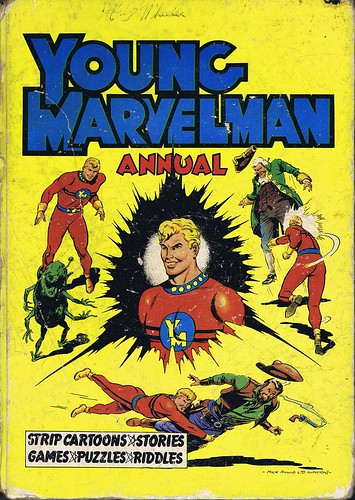
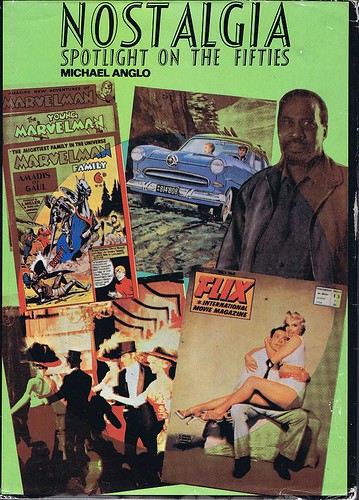
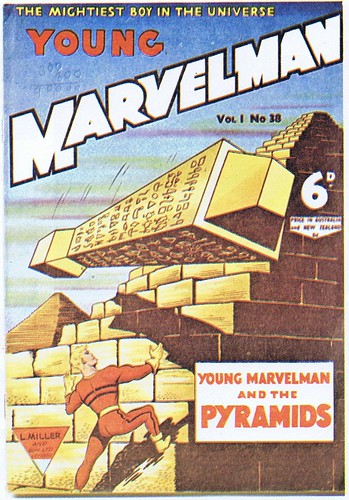
While researching the history of Marvelman, I found myself going back quite a bit farther than just to the point where Mick Anglo and Leonard Miller created the character in 1953. I actually ended up going all the way back to 1930, and the publication of Philip Wylie’s novel
Gladiator. Why? Well, If Marvelman is based on Captain Marvel, and Captain Marvel in turn is based on Superman, then I wanted to spend a little time looking at the allegation that Superman was, in his turn, supposed to be based on Hugo Danner, the protagonist in Philip Wylie’s
Gladiator. This became the first chapter of my book, and I present it here for anyone who’s sufficiently interested to read it.
Gladiator Vs Superman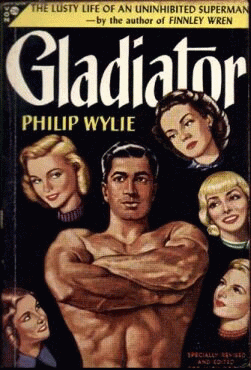
The 1949 Avon paperback publication of GladiatorGladiator, published in 1930 by Alfred A. Knopf of New York, was Philip Wylie’s third published novel, although it was his first completed one. He’d written it in 1926, at the age of twenty four, under the title of
Titan, but he didn’t want to publish a science fiction novel as his first book, and waited until two other more mainstream books,
Heavy Laden (Knopf, 1928) and
Babes and Sucklings (Knopf, 1929), appeared before finally allowing Knopf to publish it, in a somewhat different version than the original from 1926. The book features the life story and adventures of Hugo Danner. While still an unborn child in the womb, Danner is injected by his father, scientist Abednego Danner, with a serum that gives him superhuman strength and abilities. The young Danner discovers he can run at extraordinary speeds, and is extremely strong, and later finds that his skin in unbreakable, and that he can withstand bullets. This had really never been done before, surprising as it now seems. Previously, if there was a super-strong character, it was due to their circumstances. For instance, Edgar Rice Burroughs’s John Carter of Mars was super-strong because he was in the weaker gravity of Mars, and John W. Campbell's Aaron Munro, the protagonist of his 1934 novel,
The Mightiest Machine, was born on Jupiter, so was very strong when he came to Earth. Hugo Danner was different, though. He was a superhuman human being, which was a completely new concept to 1930s science fiction.
Although it didn’t sell particularly well in its original hardcover run, prompting Wylie to leave Knopf for what he saw as their lack of publicity for the book,
Gladiator was apparently a bestseller in its day, and was reviewed widely, not only in professional papers, but also in the fan press, and was well known to the science fiction fans of the time. There was even a film based on the book, Columbia Pictures’
The Gladiator, in 1938, starring Joe E. Brown and June Travis. There are two reasons these days, however, that the book crops up. The first, lesser, reason is because a copy of
Gladiator can be seen on Hollis Mason’s shelves on page nine of issue one of Alan Moore and Dave Gibbons’s
Watchmen (DC Comics, 1986). The other reason it is spoken of is because of its apparent influence on a young Jerry Siegel, writer and co-creator of the world’s comic book first superhero, Superman.
Superman, co-created by writer Jerry Siegel and artist Joe Shuster, first appeared in
Action Comics #1 in June 1938, published by Detective Comics Inc., a fore-runner of National Periodical Publications and DC Comics. The Superhero had been invented, and the world of the American comic book would never be the same again. Virtually overnight it became a huge seller, and is running to this day, with uninterrupted publication for over seventy years. A vast amount has been written over the years on the history of Superman, and by people substantially more qualified than I, so I’ll confine myself here to what is directly relevant, which is the allegation that Wylie’s
Gladiator was a significant and substantial influence on the creation of Superman.

Sam Moskowitz's Explorers of the InfiniteThe origin of the allegation that Superman was based on Hugo Danner was Sam Moskowitz’s
Explorers of the Infinite (The World Publishing Company, Cleveland, 1963), where he stated on page 278, “
In March 1930 the Book League Monthly, a paperback book club, offered its readership a selection filled with some startling situations: a man who could lift weights of four tons with ease, leap such distances that he almost seemed to fly, shed machine-gun bullets as a bridegroom sheds rice, rip bank vaults apart as though they were papier-mâché, or break a charging bull's neck with a side-handed cuff. The book was Gladiator by Philip Wylie. Most of today's readers will probably recognize the character: Superman, of course - the original.
A few years later, a Cleveland cartoonist Joe Schuster [sic] and his author associate Jerome Siegel would borrow the central theme from Gladiator, even paraphrase some of the dialogue, to create one of the most popular cartoon adventure strips of our time and no one would dream the idea had once been the basis of a serious novel.”
Philip Wylie’s biographer, Truman Frederick Keefer, also seems to agree. In
Philip Wylie (Twayne Publishers, Boston, 1977) he states on page 48, “
One of the main challenges to Wylie in writing Gladiator was the need to devise spectacular feats for Hugo to perform and then to make them seem probable. Our exposure to the Superman comic strip unfortunately obscures the originality of many of these inventions, which, according to Wylie, as well as recent scholars [presumably referring to Sam Moskowitz]
, were "borrowed" from Gladiator. Hugo hurtling across a river in a single leap, bounding fifty feet straight up in the air, holding a cannon above his head with one arm, killing a shark by ripping its jaws apart with his bare hands, felling a charging bull with a fist between the eyes, lifting an automobile by its bumper and turning it around in the road - all of these were, in 1930, fresh and new and very exciting to read about.”
Even the current publishers of
Gladiator get in on the act: the back cover of the Bison Books edition, published by University of Nebraska Press in 2004, includes this, “
An enduring classic in speculative fiction and the reported inspiration for the original comic hero, Superman, Gladiator is a melancholic tale of a boy set apart because of his unique gift and his lifelong struggle to come to terms with it.”
Gerard Jones's Men of TomorrowThere are persistent claims that Jerry Siegel had reviewed
Gladiator in the second issue of his fanzine
Science Fiction: The Advance Guard of Future Civilization, published in November 1932, most recently seen in Gerard Jones’s
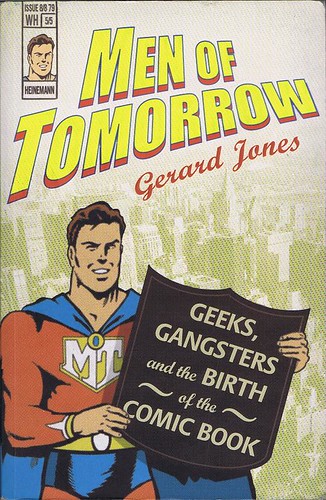
Men of Tomorrow: Geeks, Gangsters, and the Birth of the Comic Book (Basic Books, New York, 2004) where he says on page 78, “
The second issue [of
Science Fiction]
already had less to offer, except for one short piece that recorded Jerry's collision with a world very different from his own, one that sent his fantasies spinning in a new direction and pushed him closer to his first truly new creation: a review of Philip Wylie's Gladiator.”
And later, on page 80, Jones says, “
When other fans called Jerry's attention to Gladiator in 1932, it had already been on the shelves for two years. Wiley had had two more books published and was deep in his first big novel, Finnley Wren. He'd have cared nothing for a young science fiction fan's love of Gladiator (and would no doubt have been shocked to learn that eight years later he'd be preparing to sue that fan for plagiarism).”
Finally, there’s this on page 346, “
In Gladiator we find a clue to much that is mysterious about the shifting tales of Superman's creation. Siegel flatly denied that Wylie's novel had influenced him in any way, despite the timing and the striking similarities that would seem to leave no doubt of Gladiator's role. His denial seems to date from Wylie's threat to sue him for plagiarism in 1940 - Siegel reportedly even signed an affidavit attesting to it - and appears to have been a self-protective act.”
Unfortunately, despite this last piece being in the
Notes on Sources section at the rear of Jones’s book, there is no source given for any of Jones’s allegations, either of one work’s influence on the other, or of the threat of litigation.
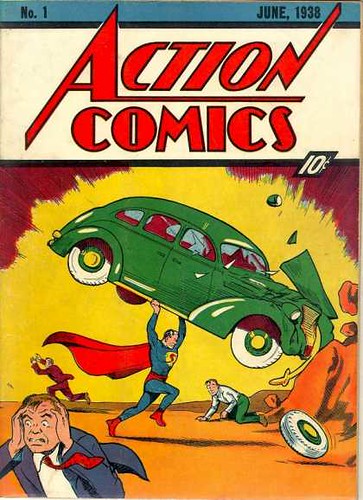
Action Comics #1There are also persistent rumours that Wylie threatened to sue National Periodical Publications, the publisher of
Action Comics, for infringement of copyright, as seen in the quotes above from Gerard Jones’s
Men of Tomorrow. In a 2008 online article on io9.com, called
Superman Takes on Other Superheroes - In Court, writer Lauren Davis says, “
In 1940, Wylie threatened to sue Siegel and National comics for plagiarism of his work. Although nothing ever came of the suit, Siegel did sign an affidavit claiming that Gladiator was not an inspiration for Superman, although Siegel had reviewed Wylie’s novel in a 1932 issue of his fanzine, Science Fiction.”
Another online article, Will Murray’s
Gladiator of Iron, says this, “
Jerry Siegel is said to have denied ever reading Gladiator. There are rumours that Philip Wylie threatened to sue DC Comics for copyright infringement in the early 40s. DC management had Siegel produce a point-by-point refutation of the charge. No suit was filed, as far as anyone knows. Rumour has it that Wylie backed down when he discovered his publisher had neglected to copyright Gladiator in the first place.”
However, as usual, no source is given for either of these claims, and a substantial amount of searching on my part has completely failed to find any verifiable evidence of either of them. And I’m not even going to
try to chase down the allegation that
Gladiator was never copyrighted in the first place, although this may just be a misplaced and mangled version of the later allegation that the copyright on Superman was abandoned by its owners.
And there, if you like, I rest the case for the prosecution...
On the other hand, there are sources that assert that Gladiator wasn’t an influence on Superman at all, or at least not as much as was being claimed by Moskowitz and those who came after him. In
Science Fiction Studies #95 (SF-TH Inc, DePauw University, Indiana, March 2005) Gregory Feeley writes, “
The claim of paraphrased dialogue would seem decisive, but a comparison of the two texts shows no such similarities. It seems unlikely that Moskowitz examined either the original 1938 Action Comics - not readily available in the early 1960s - or went back to check newspaper archives for the 1939 syndicated strip from which the earlier version was abridged. Moskowitz, who gives no source for his contention, is notorious for uncritically accepting what the writers he takes as his subjects tell him, and the biographical sketches in Explorers of the Infinite and Seekers of Tomorrow are largely hagiographic.”
He also says, “
Keefer interviewed Wylie extensively over a period of years, and he provides as much scholarly information as his subject is likely ever to get. He notes that Wylie strongly believed that Superman was largely based on Gladiator. Keefer, a competent scholar, cites Moskowitz’s claim, but notes that Moskowitz’s source was a telephone interview with Wylie. Moskowitz’s assertion thus has no independent basis, and Keefer offers no argument to support it, although he does cite a private correspondence from a third party as supporting Moskowitz.”
The “
private correspondence from a third party” mentioned above is probably J. Randolph Cox’s letter of January 30th 1970, as mentioned on page 159 of Keefer’s book, in the
Notes and References section.
With regard to the claims of litigation by Wylie against Siegel, Feeley has this to say, “
Wylie was rich and famous - and, as the admiring Keefer shows, very combative - in the late 1930s, but he seems never to have brought suit for copyright infringement. (The early litigation surrounding the copyright of Superman, in which its publisher figured as both plaintiff and defendant, has been widely discussed by comics historians.) By the time he spoke to the credulous Moskowitz in the early sixties, Wylie was an embittered alcoholic, with a long history - evident in his non-fiction, and acknowledged by Keefer - of exaggerating to make his points. The claim of paraphrased dialogue seems to have its origin there, and has been repeated (unchecked) ever since.”
The unsubstantiated claim that Siegel reviewed
Gladiator can also be called into question. Science Fiction historian Jerry Weist apparently went through long-time SF fan Forrest Ackerman's complete collection of Siegel's fanzines without finding any mention of Philip Wylie at all, let alone a review of
Gladiator. (I can’t find my source for this, I’m afraid, meaning it is for the moment unsubstantiated as well, but I saw it written down somewhere recently, and made a note of it at the time, and I’ve every reason to believe it’s correct.)
The other regularly repeated assertion about Siegel is that he always claimed not to have read
Gladiator, as can be seen in various quotes above. The truth is that, as usual, I can’t find any actual verifiable source for this, one way or another. I can’t find him claiming he didn’t read it, but I can’t find him claiming he did read it, either, or any reference to him ever being asked about it, one way or another. If fact, there’s so much supposition and unverified claims surrounding this story that even my own account of it here is necessarily filled with words like
allegedly,
apparently, and
supposedly. I’ve quoted whatever sources I can find, but in a lot of cases even these sources are vague on the sources of their own assertions. It’s obvious to me that some of the people writing about this wrote things that they
wanted to be true, and didn’t let the lack of factual evidence get in their way. Gerard Jones’s somewhat breathless prose is a good example of someone not letting the lack of facts get in the way of a good story. It’s also obvious that Gregory Feeley didn’t have a lot of time for Sam Moskowitz’s abilities as a popular culture historian, so even there one needs to filter what he says in light of this.
Of course, none of the above proves that Siegel didn’t read
Gladiator, either, and I’d have to say, for myself, that there would seem to simply be too many similarities between the two works for him not to have done so. Both characters were super-strong, virtually invulnerable, and could out-run trains. If Superman could leap tall buildings in a single bound, then Hugo Danner before him has leapt across wide rivers, and could jump fifty feet up in the air. Both broke their cribs as babies. Both kept their abilities a secret, both join football teams at one point, both spent at least some of their time forging their own brand of social justice, hunting down the likes of crooked politicians and mine-owners and making them reform their ways. Both intervene in their respective World Wars, Danner in the first, and Superman in the second. It is not just the similarities in abilities, either, but the similarities in how they dealt with those abilities, and what they chose to do with them, that make it almost a certainty, at least in my own opinion, that the young Jerry Siegel not only read Wylie’s
Gladiator, but was profoundly affected by it. At one point, as a child, Danner says to his father, "
I can do things, dad, it kinds of scares me. I can jump higher’n a house. I can run faster'n a train. I can pull up big trees and push 'em over." This could just as easily be a young Clark Kent speaking to his adoptive father Jonathan, right there.
Undoubtedly there were other influences on the creation of Superman. Jerry Siegel certainly admitted having read the Doc Savage stories, for instance, although he prevaricated somewhat in actually admitting anything beyond that. He said at one stage, when asked if Doc Savage was an influence, “
Of course I read Doc Savage at that time, but that is so long ago that I can't really intelligently answer that question,” but a number of early Superman plots are apparently lifted straight from the pages of
Doc Savage Magazine, and the fact that Savage’s actual first name was Clark, the same as Clark Kent’s, would seem to suggest that at least some form of influence was at play. Although, at that, Joe Shuster claimed that the name actually came from Clark Gable, the film actor, so once again there’s room for doubt. Other influences, according to Siegel, included the John Carter stories of Edgar Rice Burroughs, and the films of actor Douglas Fairbanks Senior, as well as Fritz Lang’s
Metropolis, after which the city in the Superman stories is named.
An interesting point in the above is that both Wylie and Siegel regularly compared their creations to, amongst others, Hercules and Atlas, who also make up the second and third letters of the acronym
SHAZAM (
S the wisdom of Solomon;
H the strength of Hercules;
A the stamina of Atlas;
Z the power of Zeus;
A the courage of Achilles;
M the speed of Mercury), the magic word that transforms Billy Batson into Captain Marvel. In this case, however, this is presumably less to do with any sort of influence or plagiarism, and more to do with the fact that, in pre-Superman days, the most obvious sources for comparisons to super-strength and other more-than-human abilities were to be found in mythology, rather than anything more contemporary.
But that was all about to change.
--------------------------------------------------------Bibliography Books: Men of Tomorrow: Geeks, Gangsters, and the Birth of the Comic Book, Gerard Jones (Basic Books, New York, 2004)
Philip Wylie, Truman Frederick Keefer (Twayne Publishers, Boston, 1977)
Explorers of the Infinite, Sam Moskowitz (The World Publishing Company, Cleveland, 1963)
Gladiator, Philip Wylie (Alfred A. Knopf, New York, 1930)
Gladiator, Philip Wylie (Bison Books, University of Nebraska Press, 2004)
--------------------------------------------------------Periodicals: Science Fiction Studies #95, Gregory Feeley (SF-TH Inc, DePauw University, Indiana, March 2005)
--------------------------------------------------------Online Articles: Superman Takes on Other Superheroes - In Court, Lauren Davis
Gladiator of Iron, Will Murray


 Eachtraí Réic Carló - Uimhir a Trí